Updated: 4 Oct 2026
WhatsApp Bot for Appointment Booking: From the Call to a WhatsApp Confirmation
A WhatsApp bot for appointment booking sends the customer a written confirmation of the booked appointment and sends the owner a summary of the call, straight to WhatsApp, with nobody typing. At Azorly this happens after every call the digital assistant answers: the customer gets a date, time and address, and you get who called, what they wanted and what is urgent. 99% of Israelis use WhatsApp, a service message on the WhatsApp Business API costs about $0.006, and the spam law allows it without separate consent as long as it carries no advertising.
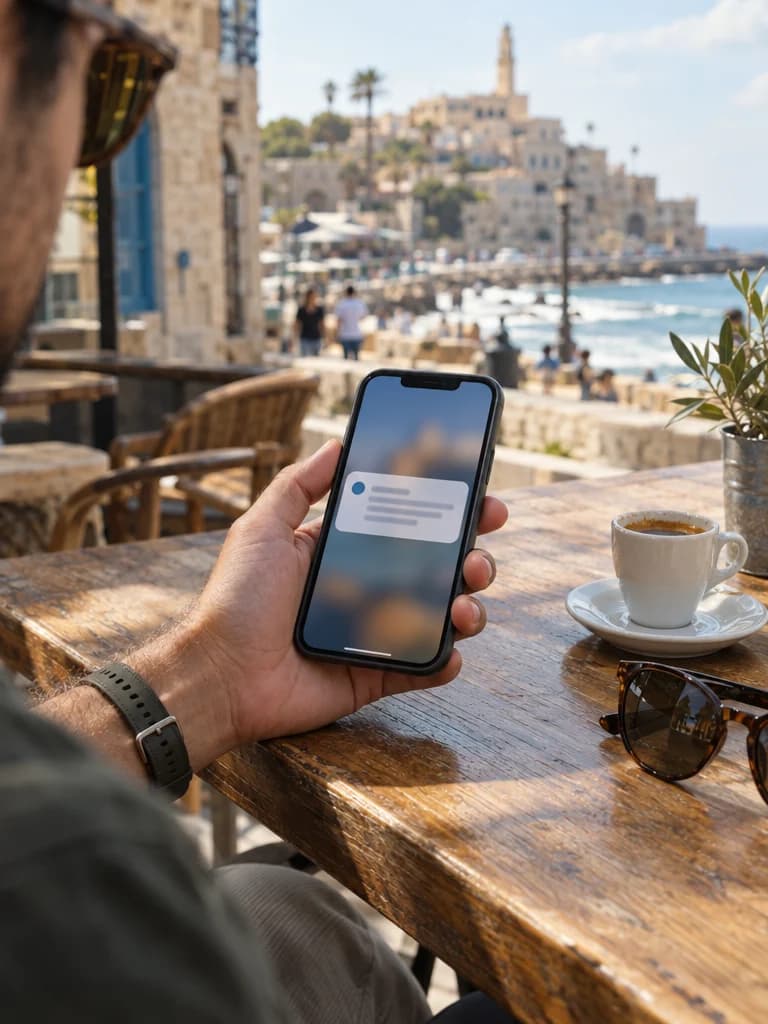
In Israel, WhatsApp is the small business's working channel. According to the Israel Internet Association survey, 99% of Israelis use it, and SMS has become the channel of banks and verification codes. That is why every Israeli AI answering service sends summaries to WhatsApp first and email second, and so does Azorly. This page explains what gets sent, to whom, what it costs and what the law allows.
What Azorly's WhatsApp bot does
At Azorly the conversation happens on the phone, and WhatsApp is the paper trail. The digital assistant answers, understands, books or logs, and at the end of the call up to three messages go out automatically.
- A summary for the owner: who called, the phone number, the request, the urgency level and a link to the inquiry in the dashboard with the recording and transcript. Sent within seconds of the call ending.
- An appointment confirmation for the customer: date, time, the therapist's or representative's name, address, and what to do to change or cancel.
- A “we saw you called” message: for a caller who hung up before the assistant answered, with a promised callback window.
These are service messages: they relate to an action the customer asked for, and they contain no promotion. That is what separates them from advertising, and the distinction matters for both the law and the cost.
What the messages look like
| Message | To | Example | Status under the spam law |
|---|---|---|---|
| Call summary | The owner or team | “Hi Danny, new call from Ronit (052-1234567) at 10:42. Topic: root canal appointment, asking for this week. Urgency: normal. Listen and details: [link]” | Internal, outside the restriction |
| Appointment confirmation | The customer | “Hello Ronit, this confirms your appointment at Dr. Levi's clinic on Wednesday 12.11 at 9:30. To change or cancel, reply to this message or call 03-5551234. Address: 10 Herzl St., Petah Tikva” | Service message, allowed without separate consent |
| We saw you called | A caller who hung up | “Hello, this is Dr. Levi's clinic. We saw you called and could not answer. You can reply here and we will get back to you by 16:00” | Service message, as long as it carries no promotion |
From call to message: what happens behind the scenes
From hang-up to the WhatsApp ping
- 1
The call ends
The assistant has finished talking with the customer. The recording and transcript are already on their way to the dashboard.
- 2
A structured summary
From the transcript a summary is built with fixed fields: name, phone, reason for calling, classification (lead, customer, urgent, supplier, spam), the promised next step.
- 3
Summary to the owner
The summary goes to the WhatsApp and email of whoever you defined. On an urgent call the message is marked as such and sent to everyone on the urgent list.
- 4
Confirmation to the customer
If an appointment was booked, a confirmation template with the details goes to the customer. If the customer asked for a callback, they get the promised window.
- 5
Status in the dashboard
The inquiry appears with status “new”. The team approves, changes or closes it, and the calendar updates.
What a business WhatsApp message costs
Since 1 July 2025 Meta bills per delivered template message rather than per conversation. The price depends on category and country, and Israel is relatively cheap. By comparison, an international SMS through Twilio costs 40 times more and never reaches a landline at all.
| Channel | Category | Price per message | Notes |
|---|---|---|---|
| WhatsApp Business API (Meta) | Utility (confirmation, summary) | $0.00636; on the rate card from 1 Oct 2026: $0.0061 | Free inside a 24-hour service window the customer opened |
| WhatsApp Business API (Meta) | Marketing (promotions) | $0.04236; from 1 Oct 2026: $0.0406 | Subject to the spam law: consent, the word “advertisement”, opt-out |
| WhatsApp Business API (Meta) | Authentication (verification code) | $0.00636; from 1 Oct 2026: $0.0061 | For login and verification codes; Azorly does not use this category |
| Israeli provider (Micropay) | WhatsApp API | ₪149 a month incl. 10,000 outgoing messages, then ₪0.01 per message | Meta fees billed separately; before VAT |
| Twilio SMS to Israel | SMS | $0.2575 per segment | No SMS to landlines; an alphanumeric sender ID needs about a week of registration |
Per call: a summary to the owner and a confirmation to the customer are two Utility messages, about ₪0.05 together. The same two messages by SMS through Twilio would cost about ₪1.90. That is why owner summaries are included in every Azorly plan, from ₪199 a month + VAT, and customer confirmations are part of the booking flow.
The spam law: what may be sent without consent
Section 30A of the Communications Law prohibits sending “advertising” by SMS, email, fax, automated dialing or WhatsApp without explicit prior written consent. Compensation to the recipient reaches ₪1,000 per message with no proof of damage, and class actions over it are common. The distinction that matters for a small business is between service and advertising.
| Message | Status | What is required to send it |
|---|---|---|
| Appointment confirmation, reminder, rescheduling | Service | Nothing beyond the appointment the customer asked for |
| “We saw you called, we will call back by 16:00” | Service | No promotion inside the message |
| Call summary to the owner | Internal | Nothing |
| “Whitening at 20% off this month” | Advertising | Explicit prior consent, the word “advertisement” at the start, sender name and details, a simple way to opt out |
| “Come back, we missed you” with a perk | Advertising | Same; the existing-customer exception applies only if, at purchase, they were told their details would be used for marketing and given a chance to refuse |
WhatsApp only, or phone plus WhatsApp
Many small businesses moved to WhatsApp only, and lose the customers who want to talk: people driving, older people, and anyone whose matter is urgent. The combination works the other way round: the assistant answers the phone and runs the conversation, and WhatsApp carries what needs to be kept in writing. The customer talks and gets a confirmation. You do not talk and get a summary.
- For a customer without WhatsApp the assistant reads the appointment details on the phone and repeats them, and the owner's summary also goes to email.
- SMS remains a backup channel only, because of its price and because it cannot be sent to a landline.
- Messages go out from a WhatsApp Business Platform account carrying the business's name, so the customer knows who it is from.
Call, book an appointment, and watch the confirmation arrive
Give customers a WhatsApp confirmation, and yourself a summary
14-day trial with no credit card. WhatsApp summaries are included in every plan, from ₪199 a month + VAT.
Start your free 14-day trialFAQ
Sources
- 99% of Israelis use WhatsApp: Israel Internet Association survey (ice.co.il) (accessed 2026-10-04)
- Meta: WhatsApp Business Platform pricing (accessed 2026-10-04)
- Gallabox: WhatsApp rate card by country, Israel row (accessed 2026-10-04)
- Twilio: changes to WhatsApp pricing, July 2025 (accessed 2026-10-04)
- Twilio: SMS pricing for Israel (accessed 2026-10-04)
- Micropay: SMS and WhatsApp API price list (accessed 2026-10-04)
- Spam law: compensation for advertising sent without consent (Kol Zchut) (accessed 2026-10-04)
- The spam law (Hebrew Wikipedia) (accessed 2026-10-04)